Turn the spec book into a project startup command center.
Pro Spec surfaces source-linked bid risks, required submittals, cross-section conflicts, and decision history before they become missed scope, rejected submittals, late RFIs, or warranty surprises.
The spec book already contains your startup risk. Most teams see it too late.
Before the first submittal package is assembled, the specification has already defined hundreds of decisions, dependencies, edge cases, and potential scope gaps. Some are obvious. Many are buried across Division 01, technical sections, warranty language, basis-of-design requirements, OFCI clauses, delegated design language, and PE-seal triggers.
Pro Spec gives construction teams a forensic read of the spec before these issues become missed scope, rejected submittals, late RFIs, warranty disputes, or avoidable bid exposure.
Not a chatbot. A project startup command center.
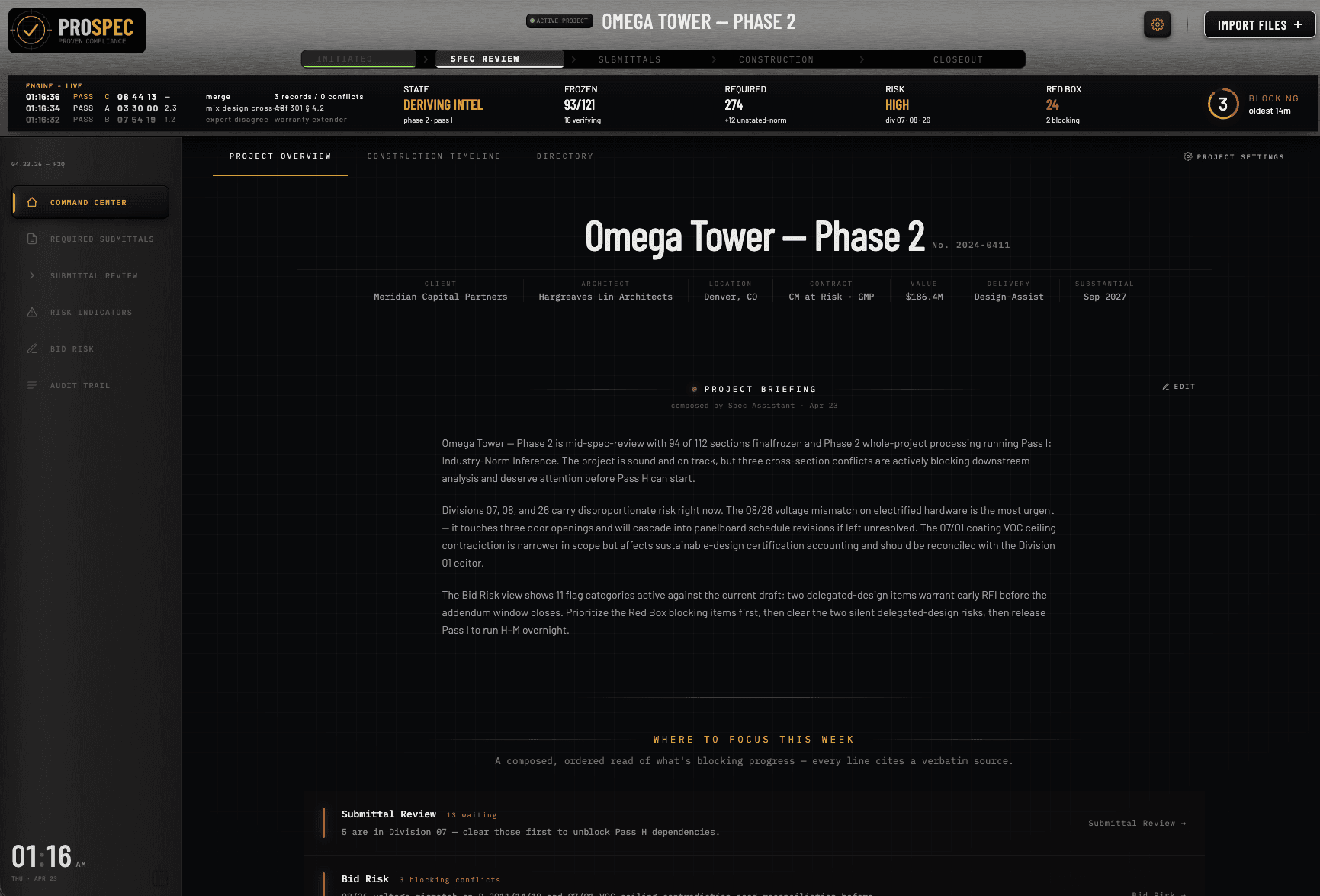
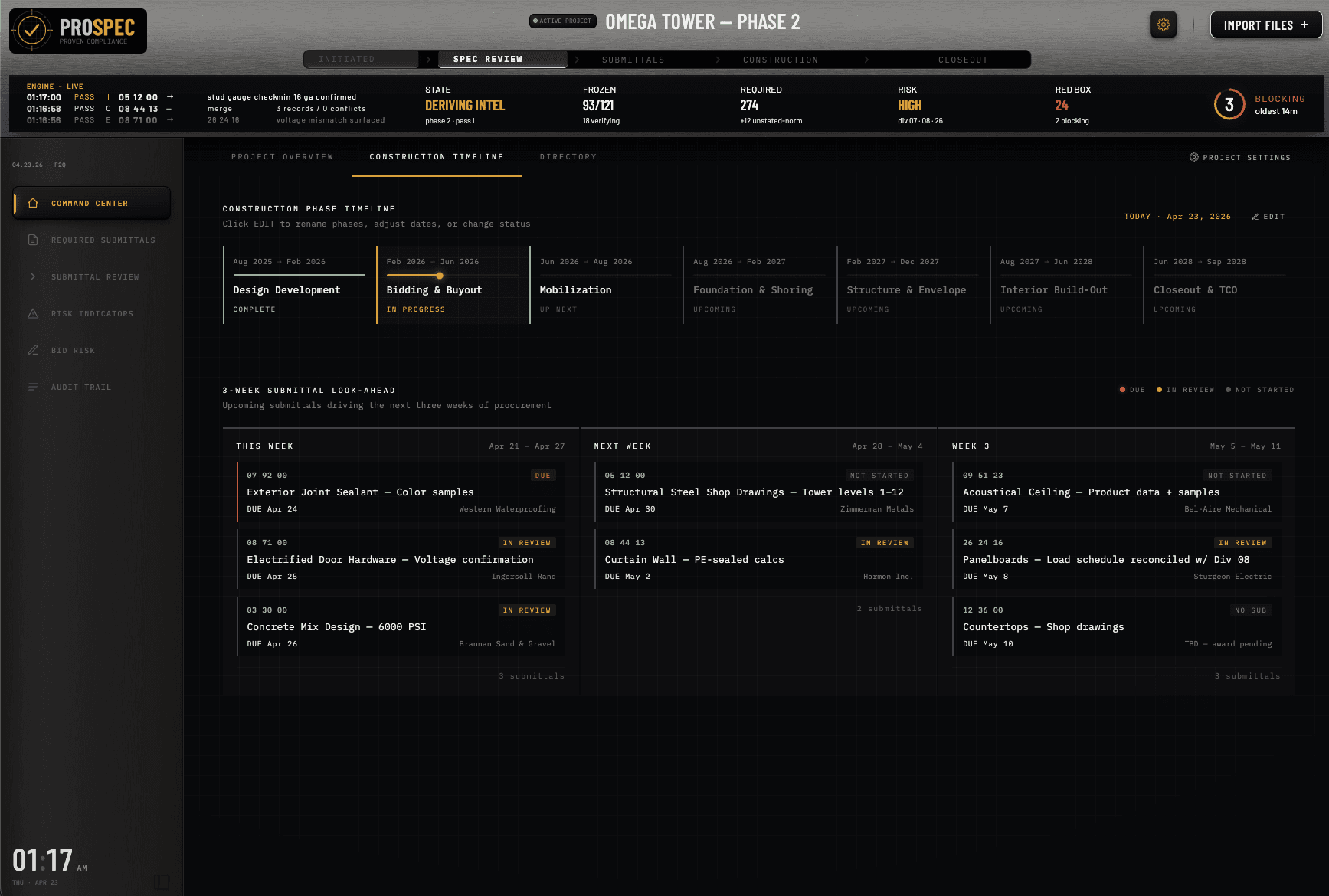
Pro Spec organizes the project around what the GC needs to review, price, clarify, push back on, assign, and document. The Command Center gives preconstruction and operations teams a live startup picture — what is frozen, what is verifying, what is blocking, which divisions carry risk, and where the next review should focus.
This is not a conversational layer over PDFs. It is structured intelligence built around source evidence, review status, risk indicators, required submittals, and decision memory.
Project state at a glance
Pass state, frozen sections, required submittals, high-risk divisions, red-box blockers, and open review areas.
Startup briefing
A concise, source-grounded read of what is blocking progress and where PMs, estimators, and preconstruction should focus first.
Workflow routing
Move from project overview to bid risk, required submittals, submittal review, audit trail, and exports — without losing source context.
Surface the risk indicators the GC should price, clarify, or push back on.
Pro Spec reviews the specification for bid-facing and startup-facing risk indicators: spec traps, silent delegated design, warranty extenders, OFCI / by-others ambiguity, BOD conflicts, unit inconsistencies, low-fidelity sections, PE-seal gaps, and cross-section conflicts.
Each finding is treated as an indicator for human review — not a legal conclusion. Pro Spec shows the source language, the affected section, the likely impact, and the recommended review posture before bid lock.
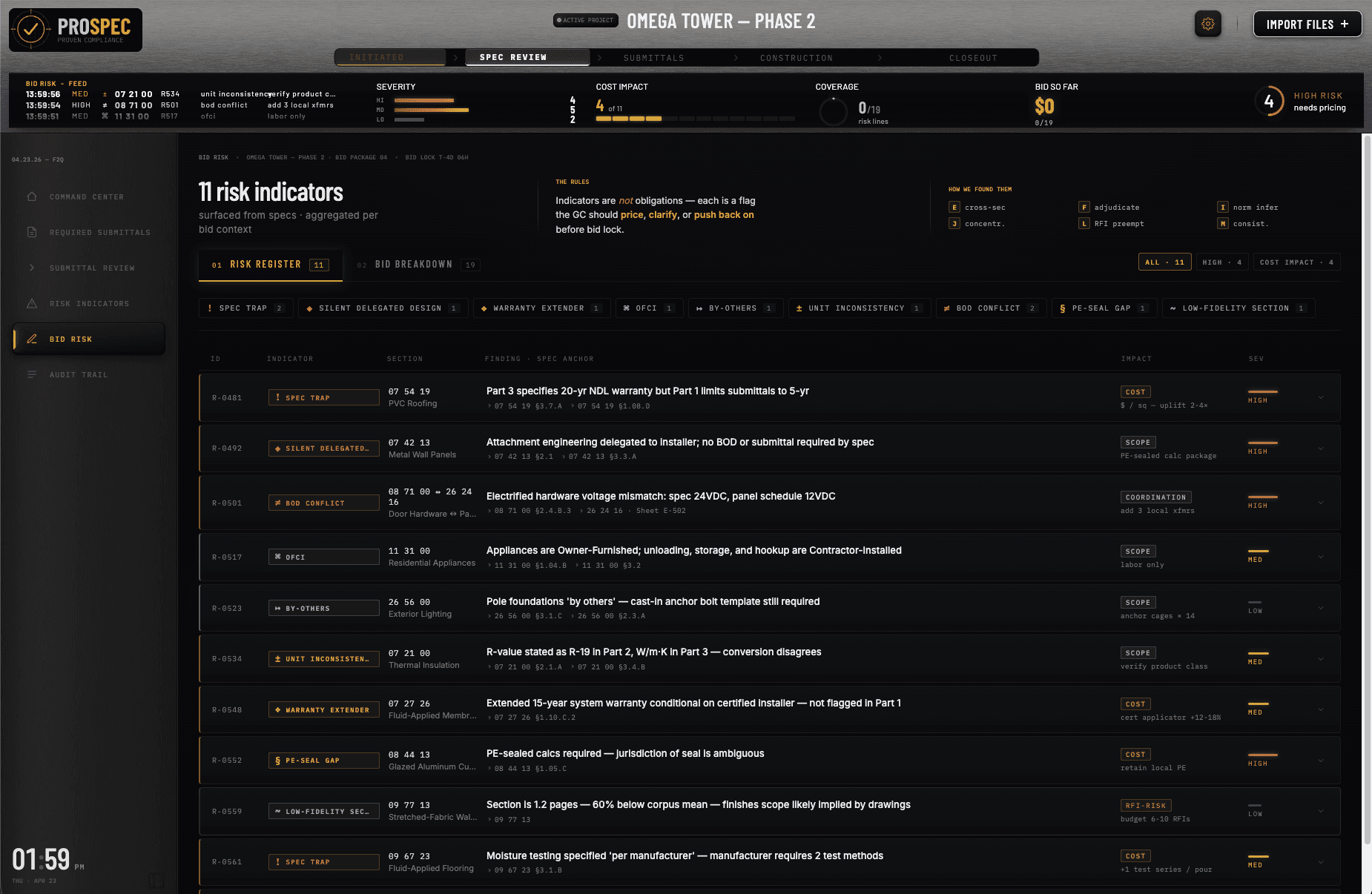
They are source-linked flags for GC review. Pro Spec helps teams identify language that may affect bid scope, startup planning, submittal strategy, or coordination risk. Final judgment stays with the project team.
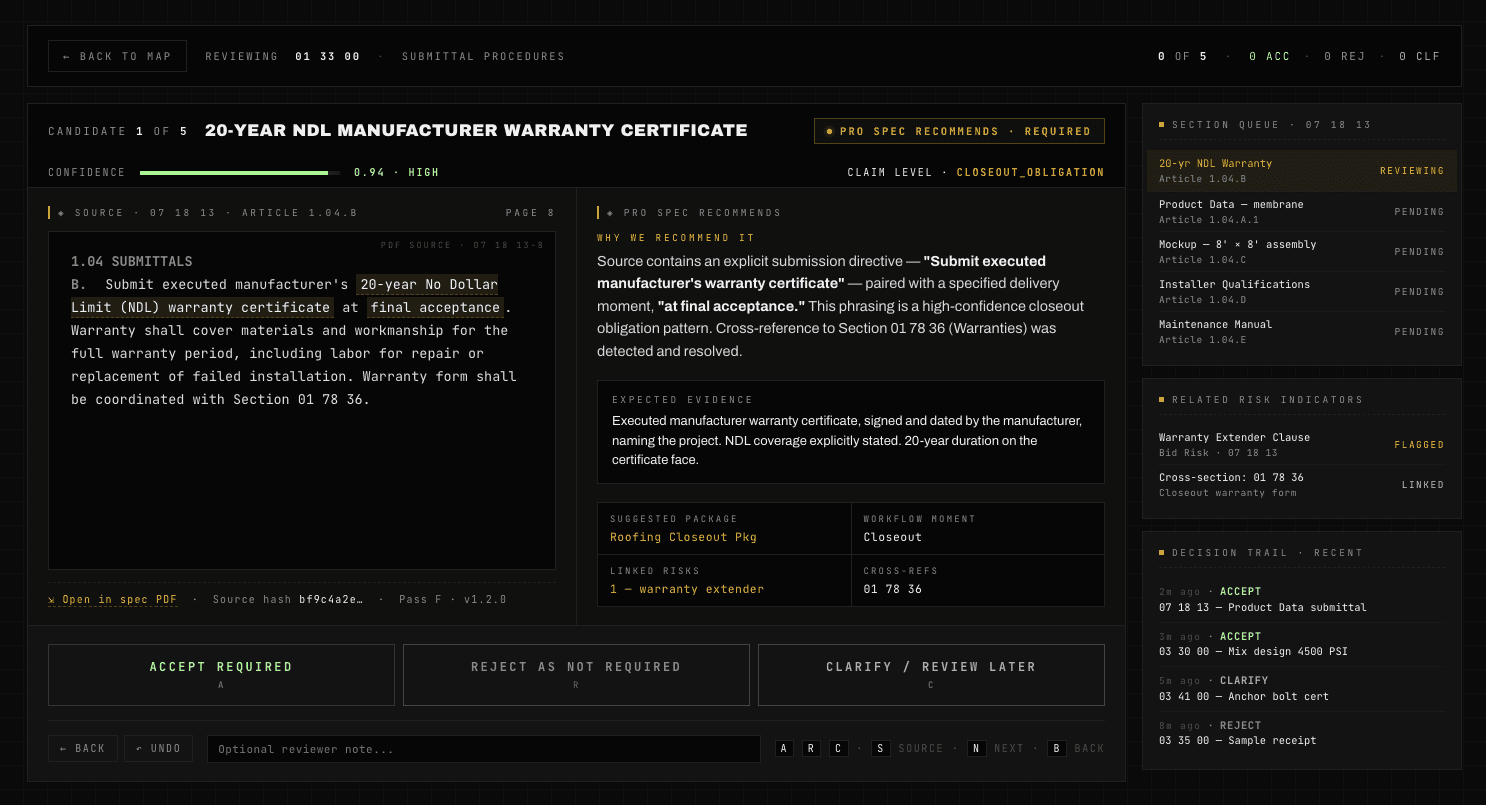
Build the required-submittal register from source evidence, not memory.
Pro Spec extracts required submittals from the spec book, groups them into reviewable packages, links each item to source evidence, and supports human verification before export.
The result is not a blind "complete log." It is a draft register with page-level evidence, package intelligence, reviewer workflow, and traceable decisions.
Source-linked register
Every required submittal ties back to the spec requirement that created it — page, section, and verbatim quote.
Package intelligence
Group related product data, shop drawings, samples, mockups, testing, warranties, and closeout items into practical review packages.
Reviewer workflow
Pass, non-compliant, notes, flags, and evidence review before the register is handed off or exported.
Find the conflicts that only appear when sections are read together.
Many project risks do not live in one section. They emerge when Division 01 requirements are compared against technical sections, when BOD language conflicts with product requirements, when warranty language is extended elsewhere, or when delegated design and PE-seal language appear without a clear submittal path.
Every finding should survive the handoff.
Pro Spec preserves the reasoning behind major findings so the project team can revisit decisions weeks or months later. Each finding can retain the source quote, page, bounding box, section, document hash, model and prompt version, verifier result, human review status, override history, timestamp, and final rationale.
That decision memory becomes a durable project record: what was flagged, why it mattered, who reviewed it, what action was taken, and which source language supported the decision.
Source quote and page context
Know exactly where the finding came from — verbatim, with anchor.
Verifier and human review state
Separate model output from reviewed project-team decisions.
Override history
Track when a finding was accepted, rejected, modified, or escalated.
Decision memory
Carry preconstruction intelligence into startup, buyout, submittals, and closeout.
Spec intelligence without surrendering document control.
Pro Spec is built around local-first trust. Document content can be processed locally or inside a GC-controlled environment, giving teams a safer way to review dense construction documents without treating project specifications as generic cloud-chat inputs.
Optional integrations can support workflow and metadata, but the trust boundary remains centered on controlled document processing, source evidence, and auditable review.
T.01 Local or GC-controlled processing
Designed for teams that need control over project document content. Process inside the boundary you already trust.
T.02 Source-linked outputs
Findings stay tied to the underlying spec language — page, section, anchor, and verbatim quote.
T.03 Human-reviewed intelligence
Pro Spec supports PM, estimator, and preconstruction judgment. It does not replace it.
T.04 Configurable workflow boundary
Use exports and integrations where helpful without turning Pro Spec into a document-management replacement.
Run a Project Startup Audit on one active spec book.
Start with a paid pilot on a real project. Pro Spec reviews the spec book for bid risk, required submittals, cross-section conflicts, delegated design signals, warranty traps, OFCI / by-others ambiguity, and source-linked decision records.
The output is a practical startup package your team can review before bid lock, buyout, submittal planning, or project kickoff.
- —Source-linked bid-risk register
- —Draft required-submittal register
- —Cross-section conflict report
- —Delegated design / PE-seal watchlist
- —Warranty and closeout risk matrix
- —OFCI / by-others ambiguity report
- —Audit trail with source evidence and human review status